Showing posts with label india. Show all posts

Wednesday, August 20, 2014

Perry Anderson,The Indian Ideology


Perry Anderson, The Indian Ideology

Formats Available
.PDF
.MOBI
Today, the Indian state claims to embody the values of a stable political democracy, a harmonious territorial unity, and a steadfast religious impartiality. Even many of those critical of the inequalities of Indian society underwrite such claims. "The Indian Ideology" suggests that the roots of the current ills of the Republic go much deeper, historically. They lie, in the way the struggle for independence culminated in the transfer of power from British rule to Congress in a divided subcontinent, not least in the roles played by Gandhi as the great architect of the movement, and Nehru as his appointed successor, in the catastrophe of Partition. Only an honest reckoning with that disaster, Perry Anderson argues, offers an understanding of what has gone wrong with the Republic since Independence. The "Idea of India," widely diffused not only in the official establishment, but more broadly in mainstream intellectual life, side-steps or suppresses many of these uncomfortable realities, past and present. For its own reasons, much of the left has yet to challenge the upshot: what has come to be the neo-Nehruvian consensus of the time. "The Indian Ideology," revisiting the events of over a century in the light of how millions of Indians fare in the Republic today, suggests another way of looking at the country.

Wednesday, July 2, 2014

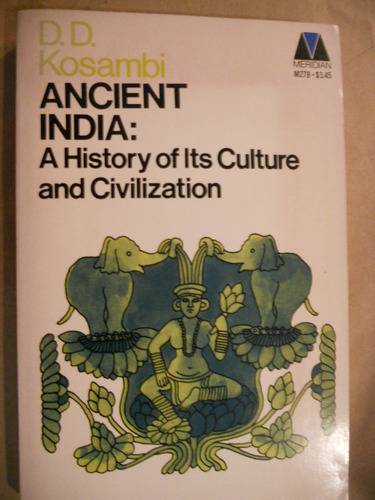
D.D. Kosambi, Ancient India: A History of Its Culture and Civilization

Formats Available:
.PDF
 A modern Marxist historian of South Asia presents a digest of ancient Indian history.

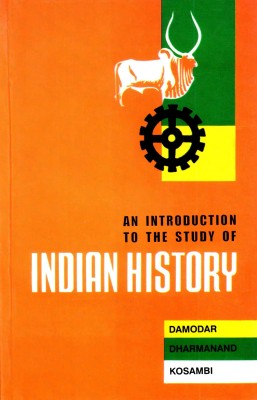
D.D. Kosambi, An Introduction to the Study of Indian History

Formats Available:
.PDF
Neutral Observer reviews Kosambi's book "An Introduction to the Study of Indian History."
Kosambi is a master of all he surveys in this book - his dexterity, scholarship and decisive judgments reminded me of Eric Hobsbawm. The book is fascinating in many respects - the choice of photographs, the detailed endnotes, the insistence on deducing historical information from observing ritual and practice among the various castes and tribes in India, the obvious comfort with the ancient history of Iran and the near east, the deep knowledge of Sanskrit and Sanskrit literature, Kosambi's scientific studies of coin hoards etc. His contempt for poor scholarship is expressed without reservation and with caustic precision. His writing is terse and elegant. It often rises to the eminently quotable.

Wednesday, July 10, 2013

The Borders of Justice (Politics History & Social Chan)

From Amazon,

"International in scope and featuring a diverse group of contributors, The Borders of Justice investigates the complexities of transitional justice that emerge from its "social embeddedness." This original and provocative collection of essays, which stem from a collective research program on social justice undertaken by the Calcutta Research Group, confronts the concept and practices of justice. The editors and contributors question the relationships between geography, methodology, and justiceohow and why justice is meted out differently in different places. Expanding on Michael Walzer's idea of the "spheres of justice," the contributors argue that justice is burdened with our notions of social realities and expectations, in addition to the influence of money, law, and government. Chapters provide close readings of Pascal, Plato, and Marx, theories on global justice, the relationship between liberalism and multiculturalism, struggles of social injustice, and how and where we draw the borders of justice.."


Formats Available

PDF (Link 1)

Ranabir Samaddar, Emergence of the Political Subject

From Amazon,

"This book is on the political subject, the conditions of its emergence, and the theoretical implications of this emergence, particularly the implications for our history. It seeks to change the way in which we understand our modern political history and the way in which it inquires into life, truth, and collective existence. The book not only marks by dense contentions different and varying histories of turbulent political moments in modern Indian history, but also presents a startling picture of the emergence of the political subject, which has been repeatedly sought to be brought under submission, but has repeatedly emerged as a mark of autonomy and agency in life."


Formats Available

PDF (Link 1)

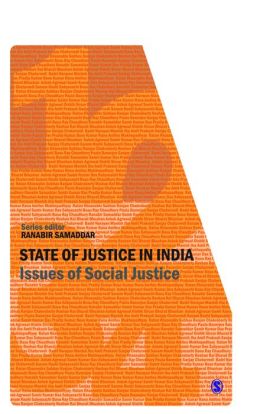
State of Justice In India: Issues of Social Justice


From Amazon,

"This set presents a comprehensive analytical study of the state of social justice in India. The four volumes undertake theoretical and empirical inquiry into the various spheres of justice, collectively creating what can be termed a report card of the regime of social justice in the country. Authored by some of the finest ethnographers and analysts in the country, this work approaches the issue of justice in the broader context of post-colonial democracy, and look at the limits within which democracy permits justice, social justice in particular."


Formats Available

PDF (Link 1)

The Politics Of Autonomy: Indian Experiences

Formats Available
PDF (Link 1)

From Snapdeal.co.in,
"This volume tells us that a critical inquiry into the idea of autonomy suggests that the politics of the future will be the politics of autonomies: an engagement that combines notions like self-government, women`s autonomy, devolution of power, the rights of minorities, greater popular access to resources, and legal pluralism, and where different autonomies must learn to negotiate and co-exist. Viewing democratic theory through the lens of autonomy, the contributors:
- argue that autonomy has to be an essential ingredient in the building of post-colonial democracies, not merely a residual measure to keep some constituencies happy;
- draw attention to the contending principles of autonomy, the consequent politics of autonomies, the inescapable co-existence of autonomies, and the need for dialogue; and
- analyze the instructive Indian politico-historical experience because of its diversity and range, the extent of colonial institutionalization, multiple forms of autonomy, the complex path of constitutionalism, a wide variety of accords, and the unyielding state that is determined to keep the nation intact. 
In the process, the contributors traverse a wide range of issues relating to women`s autonomy, peace accords, the nature of federalism in the Indian Constitution, autonomy in international law, and the fiscal decentralization. These debates are then supported by case studies on the autonomy experiments in Kashmir, Darjeeling, and the entire Northeast, and on fiscal devolution."

Sunday, June 23, 2013

Minutes of the Congress of the Peoples of the East Baku (September 1920)


"The Congress of the Peoples of the East held in Baku in September, 1920 holds a special place in the history of the Communist movement. It was the first attempt to appeal to the exploited and oppressed peoples in the colonial and semi-colonial countries to carry forward their revolutionary struggles under the banner of Marxism and with the support of the workers in Russia and the advanced countries of the world." 

--Tom Kemp, Forward to the Congress of the Peoples of the East-Baku (1920)


Saturday, May 11, 2013


Apparently published by Verso in 2007, In Our Time: Empire, Politics, Culture is touted as the anticipated and eagerly-awaited sequel to Ahmad’s indispensable — and highly recommended — In Theory: Classes, Nations, Literatures (posted here), which brilliantly critiqued theoretical takes on “post-colonialism,” homogenized “Third-World Literature” (namely Jameson), and various colonial discourses (with an emphasis on Said and Orientalism). Unfortunately, there is nothing on this text anywhere online so far as its availability goes, casting into doubt whether it is even in print, which would be something of a major misfortune for all of us that are not only familiar with his work but consider it of extreme importance juxtaposed with Western academic theoreticians/critics. Perhaps it would spark debate were it made available, which is the purpose of this post. If anyone is in possession of any information as it pertains to this text and its availability, please give your response via comment or private ask. It seems quite strange for an important text to have so quickly fallen into obscurity (or only made readily available to academics in major universities). Thank you.
The official description of the text reads as such:
The long awaited follow-up to Ahmad’s In Theory this is a meticulous analysis of the changing face of imperialism. This long-awaited sequel to In Theory offers a set of interlocking interventions in the most urgent of contemporary debates in political and cultural theory. Ahmad offers a distinctive new analysis of imperialism in the globalised era as it slides into planetary neoliberalisation and warfare, and historically novel forms of resistance emerge across the globe. Diverse in its thematics and rich in detail, In Our Time is bound to generate as much debate as its predecessor.

Aijaz Ahmad, In Theory: Classes, Nations, Literature


Aijaz Ahmad, In Theory: Classes, Nations, Literature
Formats Available
.PDF (Link I)
.PDF (Alternative Link)
Read Online
“Setting himself against the growing tendency to homogenize “Third World” literature and cultures, Aijaz Ahmad has produced a spirited critique of the major theoretical statements on “colonial discourse” and “post-colonialism,” dismantling many of the commonplaces and conceits that dominate contemporary cultural criticism. With lengthy considerations of, among others, Fredric Jameson, Edward Said, and the Subaltern Studies group, In Theory also contains brilliant analyses of the concept of Indian literature, of the genealogy of the term “Third World,” and of the conditions under which so-called “colonial discourse theory” emerged in metropolitan intellectual circles.”
Excerpt:
The brief discussion of ‘Marx on India’ in Chapter 6, the shortest in the book, is occasioned here formally by Edward Said’s attack on Marx in Orientalism precisely on the issue of India, but I also had some other aspects in mind. Polemical dismissals of Marxism, without any detailed engagement with Marx’s thought, are now a fairly common feature of French poststructuralism and of the straightforwardly right-wing ideas which have arisen in its wake. There has been, since The Order of Things, a pose of weariness and wry contempt. This is duplicated, then, in the whole range of Anglo-American literary poststructualisms — and not only literary, nor only poststructuralisms — where one routinely encounters a dense system of mutual citations and invocations of Foucault and/or Said which portrays Marx as an Orientalistic enthusiast of colonialism. A striking feature of this portrayal of Marx as an Orientalist, based as it is on some journalistic observations about India, is that it never even refers to how those same observations may have been seen by India’s own anti-imperialist historians. The key fact about the post-colonial history of the so-called Third World is that each nation-state came under the dominance of a distinct national bourgeoisie (existing or emergent) as it emerged from the colonial crucible and was then assigned a specific location in the international division of labour as it is organized by imperialism, so that the period has come to be characterized not by greater unity but by increasing differentiation and even competitiveness among these states.

Sunday, May 5, 2013


Formats Available:
PDF 1
PDF 2
Definitely read his review on Jacobin Magazine before reading this!
Excellent Marxist critique of postcolonial theory and the Subaltern Studies!
In addition, read Chibber’s marvelous essay “On The Decline Of Class Analysis In South Asian Studies”
In addition, read Terry Eagleton’s outstanding critique of Spivak’s ‘post-colonial reason’ here.
A provocative intellectual assault on the Subalternists’ foundational work.
Postcolonial theory has become enormously influential as a framework for understanding the Global South. It is also a school of thought popular because of its rejection of the supposedly universalizing categories of the Enlightenment.
In this devastating critique, mounted on behalf of the radical Enlightenment tradition, Vivek Chibber offers the most comprehensive response yet to postcolonial theory. Focusing on the hugely popular Subaltern Studies project, Chibber shows that its foundational arguments are based on a series of analytical and historical misapprehensions. He demonstrates that it is possible to affirm a universalizing theory without succumbing to Eurocentrism or reductionism.
Postcolonial Theory and the Specter of Capital promises to be a historical milestone in contemporary social theory.

Review

“With its focus on cultural identities and mixtures, postcolonial theory ignored the larger context of capitalist relations and thus limited its scope to Western academia where it excelled in the game of growing and profiting from the liberal guilt feeling. Chibber’s book simply sets the record straight, bringing postcolonialism down from cultural heights to where it belongs, into the very heart of global capitalist processes. The book we were all waiting for, a burst of fresh air dispelling the stale aroma of pseudo-radical academic establishment.” (Slavoj Žižek) “In this scrupulous and perceptive analysis, Vivek Chibber successfully shows that the ‘universalizing categories of Enlightenment thought’ emerge unscathed from the criticisms of postcolonial theorists. He shows further that—perhaps ironically—Subaltern Studies greatly underestimates the role of subaltern agency in bringing about the transformations that they attribute to the European bourgeoisie. Chibber’s analysis also provides a very valuable account of the actual historical sociology of modern European development, of Indian peasant mobilization and activism, and much else. It is a very significant contribution.” (Noam Chomsky )
“In this outstanding work—a model of clarity in its architecture and argumentation—key theorists of the ‘Subaltern’ and of postcoloniality have met their most formidable interlocutor and critic yet. Chibber’s critique of postcolonial theory and the historical sociological studies associated with it is, at the same time, a vigorous and welcome defense of the enduring value of certain Enlightenment universals as an analytical framework to both understand and radically change the world we live in” (Achin Vanaik )
“Vivek Chibber has written a stunning critique of postcolonial theory as represented by the Subaltern Studies school. While eschewing all polemics, he shows that their project is undermined by their paradoxical acceptance of an essentially liberal-Whig interpretation of the bourgeois revolutions and capitalist development in the West, which provides the foundation for their fundamental assertion of the difference of the East. Through a series of painstaking empirical and conceptual studies Chibber proceeds to overturn the central pillars of the Subalternists’ framework, while sustaining the credibility of Enlightenment theories. It is a bravura performance that cannot help but shake up our intellectual and political landscape.” (Robert Brenner )
Postcolonial Theory and the Specter of Capital is a must-read book for students of comparative politics and social theory. Vivek Chibber presents a forceful challenge to the Subaltern Studies school and to postcolonial theory more broadly. Arguing with great clarity, Chibber raises fundamental objections to their ideas about capitalism, power, and agency, and presents an alternative account of these ideas. Most fundamentally, he rejects the fundamental division between ‘East and West’ associated with postcolonial theory and defends the ‘universalizing categories of Enlightenment thought.’ This is a major contribution that is bound to reshape debate on these important issues.” (Joshua Cohen )
“In this book, Vivek Chibber has carried out a thoroughgoing dissection of Subaltern Studies. Like a highly skilled anatomist, he lays bare the skeleton, the nervous system, the arteries and veins of this school … In the process the reader is also exposed to the nitty-gritty of a materialist historiography.” (Amiya Kumar Bagchi )

About the Author

Vivek Chibber is Associate Professor of Sociology at New York University. He has contributed to, among others, the Socialist Register, American Journal of Sociology, Boston Review and New Left Review. His book Locked in Place: State-Building and Late Industrialization in India won the 2005 Barrington Moore Book Award and was one of Choice‘s Outstanding Academic Titles of 2004.