Showing posts with label sandro mezzandra. Show all posts

Wednesday, July 10, 2013

The Borders of Justice (Politics History & Social Chan)

From Amazon,

"International in scope and featuring a diverse group of contributors, The Borders of Justice investigates the complexities of transitional justice that emerge from its "social embeddedness." This original and provocative collection of essays, which stem from a collective research program on social justice undertaken by the Calcutta Research Group, confronts the concept and practices of justice. The editors and contributors question the relationships between geography, methodology, and justiceohow and why justice is meted out differently in different places. Expanding on Michael Walzer's idea of the "spheres of justice," the contributors argue that justice is burdened with our notions of social realities and expectations, in addition to the influence of money, law, and government. Chapters provide close readings of Pascal, Plato, and Marx, theories on global justice, the relationship between liberalism and multiculturalism, struggles of social injustice, and how and where we draw the borders of justice.."


Formats Available

PDF (Link 1)

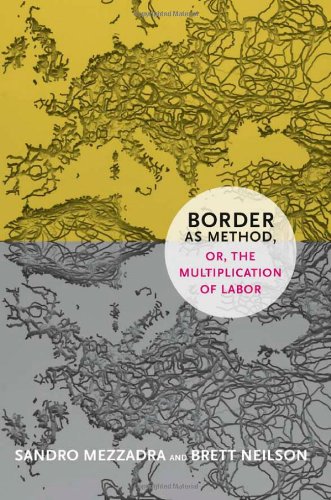
Sandro Mezzadra and Brett Neilson, Border as Method or the Multiplication of Labor


From Amazon

"Far from creating a borderless world, contemporary globalization has generated a proliferation of borders. In Border as Method, Sandro Mezzadra and Brett Neilson chart this proliferation, investigating its implications for migratory movements, capitalist transformations, and political life. They explore the atmospheric violence that surrounds borderlands and border struggles across various geographical scales, illustrating their theoretical arguments with illuminating case studies drawn from Europe, Asia, the Pacific, the Americas, and elsewhere. Mezzadra and Neilson approach the border not only as a research object but also as an epistemic framework. Their use of the border as method enables new perspectives on the crisis and transformations of the nation-state, as well as powerful reassessments of political concepts such as citizenship and sovereignty."

Formats Available

PDF (Link 1)
Scribd (Link 1)