Showing posts with label globalization. Show all posts

Thursday, September 4, 2014

John Bellamy Foster, Naked Imperialism: The U.S. Pursuit of Global Dominance


John Bellamy Foster, Naked Imperialism: The U.S. Pursuit of Global Dominance

Formats Available
.PDF
During the Cold War years, mainstream commentators were quick to dismiss the idea that the United States was an imperialist power. Even when U.S. interventions led to the overthrow of popular governments, as in Iran, Guatemala, or the Congo, or wholesale war, as in Vietnam, this fiction remained intact. During the 1990s and especially since September 11, 2001, however, it has crumbled. Today, the need for American empire is openly proclaimed and defended by mainstream analysts and commentators.

John Bellamy Foster’s Naked Imperialism examines this important transformation in U.S. global policy and ideology, showing the political and economic roots of the new militarism and its consequences both in the global and local context. Foster shows how U.S.-led global capitalism is preparing the way for a new age of barbarism and demonstrates the necessity for resistance and solidarity on a global scale.

Thursday, March 13, 2014

AK Thompson, White Riot: Anti-globalization and the Genealogy of Dissent


AK Thompson, White Riot: Anti-globalization and the Genealogy of Dissent

Formats Available
.PDF
Are you taking over, or are you taking orders?Are you going backwards, or are you going forwards?White riot—I wanna riot.White riot—a riot of my own.—The Clash, "White Riot"Ten years after the battle in Seattle sparked an historic struggle against the forces of multinational conglomeration and American imperialism, the anti-globalization generation is ready to reflect on a decade of organizing that changed the face of mass action around the globe.Scholar and activist AK Thompson revisits the struggles against globalization in Canada and the United States at the turn of the century, and he explores the connection between political violence and the white middle class. Equal parts sociological study and activist handbook, Black Bloc, White Riot engages with the key debates that arose in the anti-globalization movement over the course of the past decade: direct or mass action? Summit-hopping or local organizing? Pacifism or diversity of tactics?Drawing on movement literature, contemporary and critical theory, and practical investigations, Thompson outlines the effect of the anti-globalization movement on the white, middle-class kids who were swept up in it, and he considers how and why violence must once again become a central category of activist politics.AK Thompson is a writer and activist living and working in Toronto, Canada. Currently completing his PhD in sociology at York University, Thompson teaches social theory and serves on the editorial committee of Upping the Anti: A Journal of Theory and Action. His publications include Sociology for Changing the World: Social Movements/Social Research (Fernwood Publishing, 2006).

Tuesday, September 3, 2013

Neil Smith, American Empire: Roosevelt's Geographer and the Prelude to Globalization


Neil Smith, American Empire: Roosevelt's Geographer and the Prelude to Globalization

Formats Available:
.PDF
An American Empire, constructed over the last century, long ago overtook European colonialism, and it has been widely assumed that the new globalism it espoused took us "beyond geography." Neil Smith debunks that assumption, offering an incisive argument that American globalism had a distinct geography and was pieced together as part of a powerful geographical vision. The power of geography did not die with the twilight of European colonialism, but it did change fundamentally. That the inauguration of the American Century brought a loss of public geographical sensibility in the United States was itself a political symptom of the emerging empire. This book provides a vital geographical-historical context for understanding the power and limits of contemporary globalization, which can now be seen as representing the third of three distinct historical moments of U.S. global ambition.The story unfolds through a decisive account of the career of Isaiah Bowman (1878-1950), the most famous American geographer of the twentieth century. For nearly four decades Bowman operated around the vortex of state power, working to bring an American order to the global landscape. An explorer on the famous Machu Picchu expedition of 1911 who came to be known first as "Woodrow Wilson's geographer," and later as Frankin D. Roosevelt's, Bowman was present at the creation of U.S. liberal foreign policy. A quarter-century later, Bowman was at the center of Roosevelt's State Department, concerned with the disposition of Germany and heightened U.S. access to European colonies; he was described by Dean Acheson as a key "architect of the United Nations." In that period he was a leader in American science, served as president of Johns Hopkins University, and became an early and vociferous cold warrior. A complicated, contradictory, and at times controversial figure who was very much in the public eye, he appeared on the cover of Time magazine. Bowman's career as a geographer in an era when the value of geography was deeply questioned provides a unique window into the contradictory uses of geographical knowledge in the construction of the American Empire. Smith's historical excavation reveals, in broad strokes yet with lively detail, that today's American-inspired globalization springs not from the 1980s but from two earlier moments in 1919 and 1945, both of which ended in failure. By recharting the geography of this history, Smith brings the politics--and the limits--of contemporary globalization sharply into focus.

Thursday, July 18, 2013

Roy L. Prosterman, Robert Mitchell, Timothy Hanstad, One Billion Rising: Law, Land and the Alleviation of Global Poverty


Roy L. Prosterman, Robert Mitchell, Timothy Hanstad, One Billion Rising: Law, Land and the Alleviation of Global Poverty

Formats Available
.PDF
In an age fueled by globalization and focused on the struggling citizens of the urban metropolis, it might come as a surprise to learn that most of the world’s 1.4 billion poorest people are still rural. Unfortunately, the vast majority of these populations lack ownership of—and rights to—the land that forms their principal source of livelihood. Although land reform and related legal work have transformed the lives of millions of families by providing secure land rights, not all such efforts have succeeded. That mix of success and failure has been a big part of the reason that, in recent years, the conventional wisdom concerning law and land tenure reform—what is needed, what is possible, and how such reform contributes to pro-poor development—has changed, sometimes in striking ways. In this timely and important volume, lawyers from the Rural Development Institute and the University of Washington’s School of Law in Seattle use four decades worth of research on the results of land tenure reform efforts around the world in order to address how we might better meet the struggles to understand and change the plight of the rural poor.

Wednesday, July 10, 2013

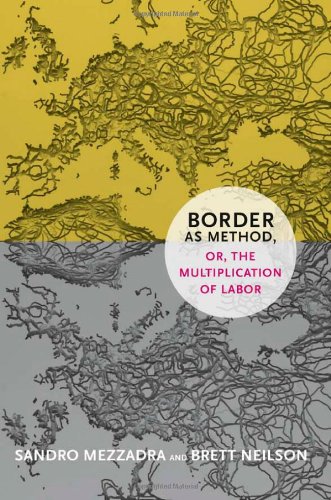
Sandro Mezzadra and Brett Neilson, Border as Method or the Multiplication of Labor


From Amazon

"Far from creating a borderless world, contemporary globalization has generated a proliferation of borders. In Border as Method, Sandro Mezzadra and Brett Neilson chart this proliferation, investigating its implications for migratory movements, capitalist transformations, and political life. They explore the atmospheric violence that surrounds borderlands and border struggles across various geographical scales, illustrating their theoretical arguments with illuminating case studies drawn from Europe, Asia, the Pacific, the Americas, and elsewhere. Mezzadra and Neilson approach the border not only as a research object but also as an epistemic framework. Their use of the border as method enables new perspectives on the crisis and transformations of the nation-state, as well as powerful reassessments of political concepts such as citizenship and sovereignty."

Formats Available

PDF (Link 1)
Scribd (Link 1)

Sunday, July 7, 2013

Michael Parenti, Blackshirts and Reds

Formats Available
PDF (LINK)
Scribd (LINK)
From Michael Parenti's site:

Blackshirts & Reds explores some of the big issues of our time: fascism, capitalism, communism, revolution, democracy and ecology—terms often bandied about but seldom explored in the original and exciting way that has become Michael Parenti's trademark.
Parenti shows how fascism renders service to capitalism, how corporate power undermines democracy, and how revolutions are a mass empowerment against the forces of exploitative privilege. He also maps out the external and internal forces that destroyed communism, and the disastrous impact of the “free-market” victory on Eastern Europe and the former Soviet Union. He affirms the relevance of taboo ideologies like Marxism, demonstrating the importance of class analysis in understanding political realities and dealing with the ongoing collision between ecology and global corporatism.
Written with lucid and compelling style, this book goes beyond truncated modes of thought, inviting us to entertain iconoclastic views, and to ask why things are the way they are. It is a bold and engaging exploration of the epic struggles of yesterday and today.
Contents
  1. Rational Fascism
  2. Plutocrats Choose Autocrats
    Whom Did the Fascists Support?
    Kudos for Benito and Adolph
    The Rational Use of Irrational Ideology
    Patriarchy and Pseudo-Revolution
    Friendly to Fascism
  3. Let Us Now Praise Revolutions
  4. The Costs of Counterrevolution
    Presumptions of Power
    Whose Violence?
    Free Market for the Few
    The Freedom of Revolution
    What Measure of Pain?
  5. Left Anticommunism
    Genuflecting to Orthodoxy
    Pure Socialism vs. Siege Socialism
    Decentralization vs. Survival
  6. Communism in Wonderland
    Rewarding Inefficiency
    Nobody Minding the Store
    Wanting It All
    Reactionism to the Surface
    Romanticizing Capitalism
  7. Stalin’s Fingers
    How Many Victims?
    Where Did the Gulag Go?
    Memories of Maldevelopment
  8. The Free-Market Paradise Goes East (I)
    Suppression of the Left
    One-Way Democracy
    Must We Adore Vaclev Havel?
    Colonizing the East
  9. The Free-Market Paradise Goes East (II)
    For Vipers and Bloodsuckers
    Shock Therapy for the Many
    Crime and Corruption
    Cultural Decay
    Women and Children Last
    “We Didn’t Realize What We Had”
  10. The End Of Marxism?
    Some Durable Basics
    More Right than Wrong
    A Holistic Science
    Compartmentalized Ideology
    Learning to Ask Why
  11. Anything But Class: Voiding The C-Word
    The Class Denial of Class
    The ABC Theorists
    Everyday Class Struggle
    A Disappearing Working Class?
    Wealth and Power
    Eco-Apocalypse, a Class Act
 

Sunday, June 2, 2013

James Erickson: Political Economy Illustrated, 1958


Cartoon/comic Marxist analysis of the critique of political economy during the Mccarthyist area. 


Formats Available:


Yildiz Atasoy, Islam's Marriage with Neo-Liberalism: State Transformation in Turkey


Yildiz Atasoy, Islam's Marriage with Neo-Liberalism: State Transformation in Turkey

Formats Available
.PDF
The transformation of the Turkish state is examined here in the context of globalized frames of neo-liberal capitalism and contemporary schemas of Islamic politics. It shows how the historical emergence of two distinct yet intertwined imaginaries of state structuring, laiklik and Islam, continues to influence Turkish politics today.

Yildiz Atasoy, Turkey, Islamists and Democracy: Transition and Globalisation in a Muslim State


Yildiz Atasoy, Turkey, Islamists and Democracy: Transition and Globalisation in a Muslim State

Formats Available
.PDF
This book examines Islam's engagement with the reorganization of the global economy. By examining the incorporation of Islam into the existing relations of the Turkish state from the late Ottoman Empire to the present day, the author demonstrates how political Islam interacts with the global restructuring of classes, states and political actors. Atasoy challenges the view of Islamist politics as an anti-Modern, anti-Western force that is fundamentally opposed to the global economy and instead argues that political Islam is cosmopolitan and embedded in processes which incorporate Western modernity into local cultural practices.

Saturday, May 18, 2013

Shahram Khosravi - Illegal Traveller: An Auto-Ethnography of Borders


Shahram Khosravi - Illegal Traveller: An Auto-Ethnography of Borders
PDF
In ‘Illegal’ Traveller, Shahram Khosravi explores the issue of borders and border crossing in the era of globalization and transnationalism, analyzing how the nation-state system regulates movements of people. In doing do, Khosravi contends that freedom of mobility for some is only possible through the organized exclusion of others.

Khosravi examines how migrant illegality is configured in the contemporary world and explores what it means to be an ‘illegal’ migrant. The focus is on a multifaceted picture of what migrant illegality is like for those who find themselves in this position. Based on his own journey and informants’ border narratives, he investigates the nature of borders, border politics, and the rituals and performances of border crossing. By focusing on individual experiences he draws attention to the implementation of policy and law. Border stories reveal the interaction between agency and structure in migratory experiences. They offer a human portrait of illegal travellers.

Saturday, May 11, 2013

NO LOGO, Naomi Klein

Eric Cazdyn and Imre Szeman, After Globalization


Eric Cazdyn and Imre Szeman, After Globalization

.PDF
In lively and unflinching prose, Eric Cazdyn and Imre Szeman argue that contemporary thought about the world is disabled by a fatal flaw: the inability to think '€œan after'€ to globalization. After establishing seven theses (on education, morality, history, future, capitalism, nation, and common sense) that challenge the false promises that sustain this time-limit, After Globalization examines four popular thinkers (Thomas Friedman, Richard Florida, Paul Krugman and Naomi Klein) and how their work is dulled by these promises. Cazdyn and Szeman then speak to students from around the globe who are both unconvinced and uninterested in these promises and who understand the world very differently than the way it is popularly represented.