Showing posts with label europe. Show all posts

Sunday, August 31, 2014

Leon Trotsky, An Appeal to the Toiling, Oppressed and Exhausted Peoples of Europe


Formats Available
.PDF
Whether calling for an end to the capitalist system, addressing the crowds after the Russian Revolution, or attacking Stalin during his years of exile, Trotsky's speeches give an extraordinary insight into a man whose words and actions determined the fates of millions. Throughout history, some books have changed the world. They have transformed the way we see ourselves - and each other. They have inspired debate, dissent, war and revolution. They have enlightened, outraged, provoked and comforted. They have enriched lives - and destroyed them. Now Penguin brings you the works of the great thinkers, pioneers, radicals and visionaries whose ideas shook civilization and helped make us who we are.

Wednesday, July 16, 2014

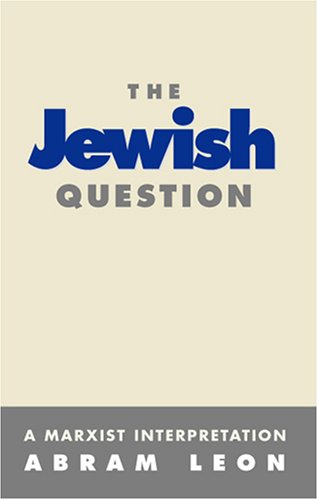
Abram Leon, The Jewish Question: A Marxist Interpretation (1942)


Formats Available:
Online (marxists.org)
 .PDF
"Traces the historical rationalizations of anti-Semitism to the fact that, in the centuries preceding the domination of industrial capitalism, Jews emerged as a "people-class" of merchants, moneylenders, and traders. Leon explains why the propertied rulers incite renewed Jew-hatred in the epoch of capitalism's decline." 


Wednesday, June 11, 2014

Luciano Canfora, Simon Jones, Democracy in Europe: A History of an Ideology (Making of Europe)


Luciano Canfora, Simon Jones, Democracy in Europe: A History of an Ideology (Making of Europe)

Formats Available
.PDF
This history traces the development of democracy in Europe from its origins in ancient Greece up to the present day.The book opens with the birth of democracy in ancient Greece, and outlines the adoption and adaptation of Greek political ideas by French revolutionaries and intellectuals to suit their own ends. The author then goes on to consider all the major watersheds in the development of democracy in modern Europe: the twenty-year crisis from 1789 to 1815, when the repercussions of revolution in France were felt across the continent; the explosion of democratic movements between 1830 and 1848; the hijacking of democratic processes by Napoleon III, and the débâcle of the Paris Commune. Canfora traces how the spread of Marxist ideas in east and west Europe, the Russian revolution, and the rise of fascism led to a "European civil war" lasting from 1914 until 1945.In conclusion, the book demonstrates how in the recent past democracy itself, far from making progress, has in fact become more limited and oligarchic, as indeed it was at the outset, 2,500 years ago.

Friday, June 21, 2013

Michel Feher, Self-Appreciation; or, The Aspirations of Human Capital (2009)

Michel Feher, Self-Appreciation; or, The Aspirations of Human Capital (2009)

Read Online
MUST-READAs early as the second half of the nineteenth century, socialist movements largely adopted the Marxist critique of the notion of the free laborer, according to which free laborers are alienated in two senses: they are alienated insofar as they do not have control over their life (i.e., they are denied the ability to choose their activity, while both the means of production and the outcome of their labor belong to others), but they are also alienated insofar as liberal law and ideology rob them of the consciousness of their exploitation (since they are invited to consider themselves as owners of their labor power and thus as subjects endowed with a freedom that is equivalent to that of their employer). However, as mentioned above, socialists did not merely recognize and expose the fictitious and ideological character of the freedom granted to the free worker: they also seized on this construct, both in an effort to bolster the price of labor power (through the work of labor unions) and to criticize working conditions (for violating the essential distinction between man and commodity, between the laborer in his or her inalienable dignity and the labor power that he or she owns and rents out).

This dual way of appropriating the figure of the free worker has allowed the labor movement to achieve considerable victories, compounded in the advent and development of the welfare state in its various dimensions. However, in the past three decades, claims based on class interests (e.g., demands for better wages and better job security) or humanist appeals (e.g., “we are not commodities”) have become less and less successful. Though this evolution, which is distinctive of the neoliberal era, can be read in terms of the crisis of the Fordist socioeconomic compact and its impact on the bargaining power of labor vis-à-vis capital, my contention is that it also reflects the decline of the type of free laborer and its gradual replacement by a new form of subjectivity: human capital. Indeed, as I shall argue, the rise of human capital as a dominant subjective form is a defining feature of neoliberalism.

Wednesday, May 8, 2013

Michel Foucault, Discipline and Punish


Michel Foucault, Discipline and Punish

Formats Available

.PDF
Among so many changes, I shall consider one: the disappearance of torture as a public spectacle. Today we are rather inclined to ignore it; perhaps, in its time, it gave rise to too much inflated rhetoric; perhaps it has been attributed too readily and too emphatically to a process of “humanization”, thus dispensing with the need for further analysis. And, in any case, how important is such a change, when compared with the great institutional transformations, the formulation of explicit, general codes and unified rules of procedure; with the almost universal adoption of the jury system, the definition of the essentially corrective character of the penalty and the tendency, which has become increasingly marked since the nineteenth century, to adapt punishment to the individual offender? Punishment of a less immediately physical kind, a certain discretion in the art of inflicting pain, a combination of more subtle, more subdued sufferings, deprived of their visible display, should not all this be treated as a special case, an incidental effect of deeper changes? And yet the fact remains that a few decades saw the disappearance of the tortured, dismembered, amputated body, symbolically branded on face or shoulder, exposed alive or dead to public view. The body as the major target of penal repression disappeared.
—Foucault, Discipline and Punish, I. Torture. 1. The Body of the Condemned