Showing posts with label palestine. Show all posts

Wednesday, July 16, 2014

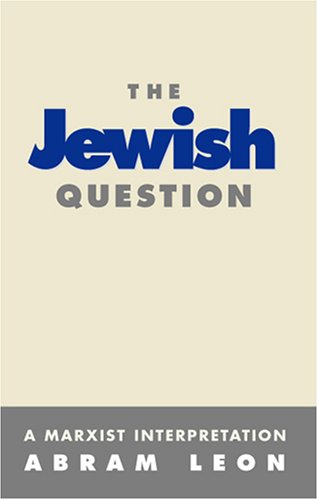
Abram Leon, The Jewish Question: A Marxist Interpretation (1942)


Formats Available:
Online (marxists.org)
 .PDF
"Traces the historical rationalizations of anti-Semitism to the fact that, in the centuries preceding the domination of industrial capitalism, Jews emerged as a "people-class" of merchants, moneylenders, and traders. Leon explains why the propertied rulers incite renewed Jew-hatred in the epoch of capitalism's decline." 


Wednesday, July 9, 2014

Maxime Rodinson, Israel: A Colonial-Settler State?


Maxime Rodinson, Israel: A Colonial-Settler State?

Formats Available
.PDF
Examines the Zionist colonization of Palestine and how the State of Israel was formed.
"Places the history of Zionism and Israel in the perspective of European expansion and colonialism in the Third World and upholds the view, accepted by most Arabs, that Israel is indeed a 'colonial-settler state' imposed by force on an unwilling Palestinian population . . . . [P]rovides abundant documentation . . . . Recommended generally for libraries with Middle East collections."-Choice
Index, Annotation, Maps

Wednesday, June 4, 2014

Sarah Irving, Leila Khaled: Fighting for Palestine


Sarah Irving, Leila Khaled: Fighting for Palestine

Formats Available
.PDF
Dubbed 'the poster girl of Palestinian militancy', Leila Khaled's image flashed across the world after she hijacked a passenger jet in 1969. The picture of a young, determined looking woman with a checkered scarf, clutching an AK-47, was as era-defining as that of Che Guevara. In this intimate profile, based on interviews with Khaled and those who know her, Sarah Irving gives us the life-story behind the image. Key moments of Khaled's turbulent life are explored, including the dramatic events of the hijackings, her involvement in the Marxist Popular Front for the Liberation of Palestine (a radical element within the PLO), her opposition to the Oslo peace process and her activism today. Leila Khaled's example gives unique insights into the Palestinian struggle through one remarkable life – from the tension between armed and political struggle, to the decline of the secular left and the rise of Hamas, and the role of women in a largely male movement.

Sunday, June 1, 2014

Gilbert Achcar, The Arabs and the Holocaust: The Arab-Israeli War of Narratives


Gilbert Achcar, The Arabs and the Holocaust: The Arab-Israeli War of Narratives

Formats Available
.EPUB
An unprecedented and judicious examination of what the Holocaust means—and doesn't mean—in the Arab world, one of the most explosive subjects of our time. There is no more inflammatory topic than the Arabs and the Holocaust—the phrase alone can occasion outrage. The terrain is dense with ugly claims and counterclaims: one side is charged with Holocaust denial, the other with exploiting a tragedy while denying the tragedies of others. In this pathbreaking book, political scientist Gilbert Achcar explores these conflicting narratives and considers their role in today's Middle East dispute. He analyzes the various Arab responses to Nazism, from the earliest intimations of the genocide, through the creation of Israel and the destruction of Palestine and up to our own time, critically assessing the political and historical context for these responses. Finally, he challenges distortions of the historical record, while making no concessions to anti-Semitism or Holocaust denial. Valid criticism of the other, Achcar insists, must go hand in hand with criticism of oneself.Drawing on previously unseen sources in multiple languages, Achcar offers a unique mapping of the Arab world, in the process defusing an international propaganda war that has become a major stumbling block in the path of Arab-Western understanding. 

Wednesday, July 17, 2013

Gilbert Achcar, Eastern Cauldron: Islam, Afghanistan, Palestine, and Iraq in a Marxist Mirror


Gilbert Achcar, Eastern Cauldron: Islam, Afghanistan, Palestine, and Iraq in a Marxist Mirror

Formats Available
.PDF
The route to any coherent understanding of our time runs through the issues addressed in this collection of essays: the political meaning of Islam, the relation of the West to the Islamic world, the new form of imperialism signaled by the Soviet and U.S. occupations of Afghanistan, the intractable conflict over Palestine. In confronting these inescapable issues, global power is being reshaped and the ends for which it will be used are being decided. This volume brings together Gilbert Achcar's major writings on these issues over the past decades. The essays collected in Eastern Cauldron describe and explain the resurgence of Islamic fundamentalism, the fate of the Soviet occupation of Afghanistan and its aftermath, and above all the Palestinian conflict—in which the regional stakes are so dramatically embodied and contested. Achcar analyzes the social bases, strategies and tactics of PLO, Hezbollah, Israel and the United States from the establishment of the state of Israel to the second Intifada. He pinpoints the contradictions of the Israeli state—seeking at the same time to be Jewish and yet democratic—and the impact of these contradictions on all parties to the conflict. Eastern Cauldron is primarily aimed at producing a better understanding of the conflicts of the region. Achcar's work is informed by strong moral and political commitments but is never limited to polemic. His work demonstrates the immense capacities of Marxism to illuminate economic, political, and ideological developments without losing sight of their concrete singularity and their complex interconnection. His analyses are supple and inventive, and consistently informed by reflection on rival traditions of political thought and a deep knowledge of the region.

Wednesday, May 15, 2013

Catherine Cook, Adam Hanieh, Adah Kay, Stolen Youth: The Politics of Israel's Detention of Palestinian Children (2004)


Catherine Cook, Adam Hanieh, Adah Kay, Stolen Youth: The Politics of Israel's Detention of Palestinian Children (2004)

Formats Available
.PDF
Stolen Youth is the first book to explore Israel's incarceration of Palestinian children. Based on first-hand information from international human rights groups and NGO workers in the West Bank and Gaza Strip, it also features interviews with children who have been imprisoned. The result is a disturbing and often shocking account of the abuses that are being carried out by Israel, and that have been widely documented by human rights groups such as Amnesty, but yet have never been addressed by the international community.The book presents a critical analysis of the international legal framework and the UN system, arguing that a major failure of these instuitutions is their appeal to neutrality while ignoring the reality of power. The book attempts to address the inadequacy of these institutions by placing the issue of Palestinian child prisoners within the framework of Israeli strategy and the overall system of control.The book is divided into three main sections: the first chapters introduce the major issues, and propose a framework for understanding Israel's policy towards Palestinian detainees, particularly children. The second section examines the actual experience of children from the moment of arrest until their release from prison based on hundreds of affidavits collected from children released from prison. The final section of the book analyses in detail the reasons underlying Israel's incarceration of children and the impact on Palestinian society. It outlines Israel's system of institutionalized discrimination and state torture, challenges the legitimacy of Israel's 'security' argument, and argues that Israel's treatment of Palestinian detainees forms one pillar of a policy designed to quash resistance to the occupation.

Israel Shahak, Norton Mezvinsky, Jewish Fundamentalism In Israel: New Introduction by Norton Mezvinsky (2004)


Israel Shahak, Norton Mezvinsky, Jewish Fundamentalism In Israel: New Introduction by Norton Mezvinsky (2004)

Formats Available
.PDF
At the very heart of the modern world is the idea that all people are born equal. Yet the Jewish religion teaches that people of Jewish faith are special before God, and Jewish fundamentalism passionately defends this belief. This book considers the consequences of this belief in the light of the considerable political influence and power of Jewish fundamentalism. The authors make a clear distinction between the fundamentalist ideology of Israel's Ashkenazi Jews and that of the Sephardic Jews, examining the growing impact of these two movements on Israel's political processes and their effects at a grassroots level through the armed forces' relations with the Palestinian population. Shahak and Mezvinsky argue that Israeli Jewish fundamentalism is closely associated with a new form of national religious Messianism which has its origins in the settling of the conquered territories during the war of 1967 and which vehemently opposes the peace process. Focusing on the consequences for Israel of these ideologies, the authors examine in particular the activities of fundamentalist groups and individuals. Shahak and Mezvinsky conclude by analyzing the possible scenario of civil war in Israel between religious fundamentalists and secularists.

Naseer Aruri, Palestinian Refugees: The Right of Return (2001)


Naseer Aruri, Palestinian Refugees: The Right of Return (2001)

Formats Available
.PDF
With renewed conflict in the Middle East, the prospect of a peaceful resolution looks more unlikely than ever. The Palestinian right of return to their homes has been upheld in international law and through United Nations' resolutions for fifty years. Equally the right of return has been denied by Israel and deferred to a "final status" issue in the Oslo Accords. It is on this right of return that the Palestinians are united. And it is this issue which is so frequently ignored by the international media. With major contributions from a range of international experts, including Edward W. Said, Noam Chomsky, Ilan Pappe, Alain Gresh and Norman Finkelstein, this volume examines the Palestinians’ right of return. Chapters cover the historical roots of the Palestinian refugee question; the rights of the refugees under international law; the special case of Lebanon; Israeli perceptions of the refugee question; the practical feasibility of the return; the role of the United States and the European Union and the Refugee Question; the value of the refugee property; the principles of compensation; and a programme for an Independent Rights Campaign.

Jeff Halper, An Israeli in Palestine: Resisting Dispossession, Redeeming Israel (2008)


Jeff Halper, An Israeli in Palestine: Resisting Dispossession, Redeeming Israel (2008)

Formats Available
.PDF
Jeff Halper is an Israeli who lives and works in Palestine. This book throws a critical light on the Israeli-Palestinian conflict from an Israeli point of view. Israel's pioneers created a vibrant society, culture and economy. Yet the idea of an ethnically-pure "Jewish State" is no longer viable. Only 72 per cent of Israelis are Jewish, and this proportion is dwindling. To enforce its ethnic exclusivity, Israel adopts policies of occupation and discrimination against Palestinian citizens.Halper puts forward a passionate argument for a new Israel that finds its identity not through ethnicity, but through new ideological and legal frameworks that respect all human rights, and that fundamentally realign Israel's position within the Middle East. Halper explains why a two-state solution will never solve issues such as human rights, refugees, security, access to water and economic development. Instead he develops a positive vision for a new state where Palestinians and Israelis live side by side.

Baruch Kimmerling, Clash of Identities: Explorations in Israeli and Palestinian Societies (2008)


Baruch Kimmerling, Clash of Identities: Explorations in Israeli and Palestinian Societies (2008)

Formats Available
.PDF
By revisiting the past hundred years of shared Palestinian and Jewish-Israeli history, Baruch Kimmerling reveals surprising relations of influence between a stateless indigenous society and the settler-immigrants who would later form the state of Israel. Shattering our assumptions about these two seemingly irreconcilable cultures, Kimmerling composes a sophisticated portrait of one side's behavior and characteristics and the way in which they irrevocably shaped those of the other.Kimmerling focuses on the clashes, tensions, and complementarities that link Jewish, Palestinian, and Israeli identities. He explores the phenomena of reciprocal relationships between Jewish and Arab communities in mandatory Palestine, relations between state and society in Israel, patterns of militarism, the problems of jurisdiction in an immigrant-settler society, and the ongoing struggle of Israel to achieve legitimacy as both a Jewish and a democratic state. By merging Israeli and Jewish studies with a vast body of scholarship on Palestinians and the Middle East, Kimmerling introduces a unique conceptual framework for analyzing the cultural, political, and material overlap of both societies. A must read for those concerned with Israel and the relations between Jews and Arabs, Clash of Identities is a provocative exploration of the ever-evolving, always-contending identities available to Israelis and Palestinians and the fascinating contexts in which they take form.

Jonathan Cook, Blood and Religion: The Unmasking of the Jewish and Democratic State (2006)


Jonathan Cook, Blood and Religion: The Unmasking of the Jewish and Democratic State (2006)

Formats Available
.PDF
What does Israel hope to achieve with its recent withdrawal from Gaza and the building of a 700km wall around the West Bank? Jonathan Cook, who has reported on the Israeli-Palestinian conflict during the Second Intifada, presents a lucid account of the Jewish state's motives. The heart of the issue, he argues, is demography. Israel fears the moment when the region’s Palestinians – Israel's own Palestinian citizens and those in the Occupied Territories – become a majority. Inevitable comparisons with apartheid in South Africa will be drawn. The book charts Israel’s increasingly desperate responses to its predicament: -- military repression of Palestinian dissent on both sides of the Green Line -- accusations that Israel's Palestinian citizens and the Palestinian Authority are secretly conspiring to subvert the Jewish state from within -- a ban on marriages between Israel’s Palestinian population and Palestinians living under occupation to prevent a right of return ‘through the back door’ -- the redrawing of the Green Line to create an expanded, fortress state where only Jewish blood and Jewish religion count Ultimately, concludes the author, these abuses will lead to a third, far deadlier intifada.

Baruch Kimmerling, The Invention and Decline of Israeliness: State, Society, and the Military (2001)


Baruch Kimmerling, The Invention and Decline of Israeliness: State, Society, and the Military (2001)

Formats Available
.PDF
This thought-provoking book, the first of its kind in the English language, reexamines the fifty-year-old nation of Israel in terms of its origins as a haven for a persecuted people and its evolution into a multi- cultural society. Arguing that the mono-cultural regime built during the 1950s is over, Baruch Kimmerling suggests that the Israeli state has divided into seven major cultures. These seven groups, he contends, have been challenging one other for control over resource distribution and the identity of the polity. Kimmerling, one of the most prominent social scientists and political analysts of Israel today, relies on a large body of sociological work on the state, civil society, and ethnicity to present an overview of the construction and deconstruction of the secular-Zionist national identity. He shows how Israeliness is becoming a prefix for other identities as well as a legal and political concept of citizen rights granted by the state, though not necessarily equally to different segments of society.

Ghada Karmi, Married to Another Man: Israel's Dilemma in Palestine (2007)


Ghada Karmi, Married to Another Man: Israel's Dilemma in Palestine (2007)

Formats Available
.PDF
Two rabbis,visiting Palestine in 1897,observed that the land was like a bride,''beautiful,but married to another man''. By which they meant that, if a place was to be found for Israel in Palestein,where would the people of Palestine go? This is a dilemma that Israel has never been able to resolve.Ð’ No conflict today is more dangerous than that between Israel and the Palestinians. The implications it has for regional and global security cannot be overstated. The peace process as we know it is dead and no solution is in sight. Nor, as this book argues, will that change until everyone involved in finding a solution accepts the real causes of conflict, and its consequences on the ground.Ð’ Leading writer Ghada Karmi explains in fascinating detail the difficulties Israel's existence created for the Arab world and why the search for a solution has been so elusive. Ultimately,she argues that the conflict will end only once the needs of both Arabs and Israelis are accommodated equally. Her startling conclusions overturn conventional thinking-but they are hard to refute.

Eyal Weizman, Hollow Land: Israel's Architecture of Occupation (2007)


Eyal Weizman, Hollow Land: Israel's Architecture of Occupation (2007)

Formats Available
.PDF
Groundbreaking expos? of Israel’s terrifying reconceptualization of geopolitics in the Occupied Territories and beyond.Hollow Land is a groundbreaking exploration of the political space created by Israel’s colonial occupation. In this journey from the deep subterranean spaces of the West Bank and Gaza to their militarized airspace, Eyal Weizman unravels Israel’s mechanisms of control and its transformation of the Occupied Territories into a theoretically constructed artifice, in which all natural and built features function as the weapons and ammunition with which the conflict is waged. Weizman traces the development of these ideas, from the influence of archaeology on urban planning, Ariel Sharon’s reconceptualization of military defense during the 1973 war, through the planning and architecture of the settlements, to contemporary Israeli discourse and practice of urban warfare and airborne targeted assassinations. In exploring Israel’s methods to transform the landscape and the built environment themselves into tools of domination and control, Hollow Land lays bare the political system at the heart of this complex and terrifying project of late-modern colonial occupation.

Norman G. Finkelstein, This Time We Went Too Far (2010)


Norman G. Finkelstein, This Time We Went Too Far (2010)

Formats Available
.PDF
For the Palestinians who live in the narrow coastal strip of Gaza, the December 2008 Israeli invasion was a nightmare of unimaginable proportions: in the 22-day-long action 1,400 Gazans were killed, several hundred on the first day alone. More than 6,000 homes were destroyed or badly damaged. The cost of the destruction and disruption of economic life, in one of the world’s poorest areas, is estimated at more than $3 billion.

And yet, while nothing should diminish recognition of Palestinian suffering through these frightful days, it is possible something redemptive will emerge from the tragedy of Gaza. For, as Norman Finkelstein details, in a concise work that melds cold anger with cool analysis, the profound injustice of the Israeli assault has been widely recognized by organizations impossible to brand as partial or extremist.

Amnesty International, Human Rights Watch, and the UN investigation headed by Richard Goldstone, in documenting Israel's use of indiscriminate and intentional force against the civilian population during the invasion (100 Palestinians died for every one Israeli), have had an impact on traditional support for Israel. Jews in both the United States and the United Kingdom, for instance, are beginning to voice dissent, and this trend is especially apparent among the young.

Such a shift, Finkelstein contends, can result in new pressure capable of moving the Middle East crisis towards a solution, one that embraces justice for Palestinians and Israelis alike. The seeds of hope were thus sown in the bitter anguish of Gaza. This Time We Went Too Far, written with Finkelstein’s customary acuity and precision, will surely advance the process it so eloquently describes.

Eugene L. Rogan, Avi Shlaim, The War for Palestine: Rewriting the History of 1948 (2007)


Eugene L. Rogan, Avi Shlaim, The War for Palestine: Rewriting the History of 1948 (2007)

Formats Available
.PDF
The 1948 war led to the creation of the state of Israel, the fragmentation of Palestine, and to a conflict which has raged across the intervening sixty years. The historical debate likewise continues and these debates are encapsulated in the second edition of The War for Palestine, updated to include chapters on Saudi Arabia and Lebanon. In a preface to the new edition, the editors survey the state of scholarship in this contested field. The impact of these debates goes well beyond academia. There is an important link between the state of Arab-Israeli relations and popular attitudes towards the past. A more complex and fair-minded understanding of that past is essential for preserving at least the prospect of reconciliation between Arabs and Israel in the future. The rewriting of the history of 1948 thus remains a practical as well as an academic imperative.

Gregory Harms, Todd Ferry, The Palestine-Israel Conflict: A Basic Introduction (2008)


Gregory Harms, Todd Ferry, The Palestine-Israel Conflict: A Basic Introduction (2008)

Formats Available
.PDF
This is a well-written, concise, and unbiased overview of a complex situation. It's a quick enjoyable read and written in a very accessible style. I've read it at least three times. I've given it away to several friends and am always buying new copies. Why? I'm passionate about this topic and while people who agree with me do not hate this book, they are not excited about it either. That tells me it's right on the mark. I've written few Amazon reviews, but felt compelled to recommend this excellent book.

Norman G. Finkelstein, The Holocaust Industry: Reflections on the Exploitation of Jewish Suffering (2003)


Norman G. Finkelstein, The Holocaust Industry: Reflections on the Exploitation of Jewish Suffering (2003)

Formats Available
.PDF
In a devastating new postscript to this best-selling book, Norman G. Finkelstein documents the Holocaust industry's scandalous cover-up of the blackmail of Swiss banks, and in a new appendix demolishes an influential apologia for the Holocaust industry.It was not until the Arab-Israeli War of 1967, when Israel's evident strength brought it into line with US foreign policy, that memory of the Holocaust began to acquire the exceptional prominence it enjoys today. Leaders of America's Jewish community were delighted that Israel was now deemed a major strategic asset and, Finkelstein contends, exploited the Holocaust to enhance this new-found status. Their subsequent interpretations of the tragedy are often at variance with actual historical events and are employed to deflect any criticism of Israel and its supporters. Recalling Holocaust fraudsters such as Jerzy Kosinski and Binjamin Wilkomirski, as well as the demagogic constructions of writers like Daniel Goldhagen, Finkelstein contends that the main danger posed to the memory of Nazism's victims comes not from the distortions of Holocaust deniers but from prominent, self-proclaimed guardians of Holocaust memory. Drawing on a wealth of untapped sources, he exposes the double shakedown of European countries as well as legitimate Jewish claimants, and concludes that the Holocaust industry has become an outright extortion racket. Thoroughly researched and closely argued, The Holocaust Industry is all the more disturbing and powerful because the issues it deals with are so rarely discussed.

Jacqueline Rose, The Question of Zion (2005)


Jacqueline Rose, The Question of Zion (2005)

Formats Available
.PDF
Zionism was inspired as a movement--one driven by the search for a homeland for the stateless and persecuted Jewish people. Yet it trampled the rights of the Arabs in Palestine. Today it has become so controversial that it defies understanding and trumps reasoned public debate. So argues prominent British writer Jacqueline Rose, who uses her political and psychoanalytic skills in this book to take an unprecedented look at Zionism--one of the most powerful ideologies of modern times. Rose enters the inner world of the movement and asks a new set of questions. How did Zionism take shape as an identity? And why does it seem so immutable? Analyzing the messianic fervor of Zionism, she argues that it colors Israel's most profound self-image to this day. Rose also explores the message of dissidents, who, while believing themselves the true Zionists, warned at the outset against the dangers of statehood for the Jewish people. She suggests that these dissidents were prescient in their recognition of the legitimate claims of the Palestinian Arabs. In fact, she writes, their thinking holds the knowledge the Jewish state needs today in order to transform itself. In perhaps the most provocative part of her analysis, Rose proposes that the link between the Holocaust and the founding of the Jewish state, so often used to justify Israel's policies, needs to be rethought in terms of the shame felt by the first leaders of the nation toward their own European history. For anyone concerned with the conflict in Israel-Palestine, this timely book offers a unique understanding of Zionism as an unavoidable psychic and historical force.

Norman G. Finkelstein, Beyond Chutzpah: On the Misuse of Anti-Semitism and the Abuse of History (2008)


Norman G. Finkelstein, Beyond Chutzpah: On the Misuse of Anti-Semitism and the Abuse of History (2008)

Formats Available
.PDF
In this long-awaited sequel to his international bestseller The Holocaust Industry, Norman G. Finkelstein moves from an iconoclastic interrogation of the new anti-Semitism to a meticulously researched expos? of the corruption of scholarship on the Israel-Palestine conflict.Bringing to bear the latest findings on the conflict and recasting the scholarly debate, Finkelstein points to a consensus among historians and human rights organizations on the factual record. Why, then, does so much controversy swirl around the conflict? Finkelstein's answer, copiously documented, is that apologists for Israel contrive controversy. Whenever Israel comes under international pressure, another media campaign alleging a global outbreak of anti-Semitism is mounted.Finkelstein also scrutinizes the proliferation of distortion masquerading as history. Recalling Joan Peters' book From Time Immemorial, published to great fanfare in 1984 but subsequently exposed as an academic hoax, he asks deeply troubling questions here about the periodic reappearance of spurious scholarship and the uncritical acclaim it receives. The most recent addition to this genre, Finkelstein argues, is Harvard Law Professor Alan Dershowitz's bestseller, The Case for Israel.The core analysis of Beyond Chutzpah sets Dershowitz's assertions on Israel's human rights record against the findings of the mainstream human rights community. Sifting through thousands of pages of reports from organizations such as Amnesty International, B'Tselem, and Human Rights Watch, Finkelstein argues that Dershowitz has misrepresented the facts.Thoroughly researched and tightly argued, Beyond Chutzpah lifts the veil of controversy shrouding the Israel-Palestine conflict.