Sunday, July 5, 2015

Allen W. Wood, The Free Development of Each: Studies on Freedom, Right, and Ethics in Classical German Philosophy


Allen W. Wood, The Free Development of Each: Studies on Freedom, Right, and Ethics in Classical German Philosophy
.PDF
The Free Development of Each collects twelve essays on the history of German philosophy by Allen W. Wood, one of the leading scholars in the field. They explore moral philosophy, politics, society, and history in the works of Kant, Herder, Fichte, Hegel, and Marx, and share the basic theme of freedom, as it appears in morality and in politics.
All of the essays have been re-edited and revised for this collection, and five are previously unpublished. They are accompanied by an Introduction which sets out the central, philosophical viewpoint of the volume, and a comprehensive bibliography.

Sunday, March 15, 2015

Roland Boer, On Marxism and Theology Series I, II, III, and V


Roland Boer, On Marxism and Theology Series I, II, III, and V

Formats Available:
Series I (.PDF)Series II (.PDF)Series III (.PDF)Series V (.PDF)


Roland Boer, Criticism of Earth: On Marx, Engels and Theology


Roland Boer, Criticism of Earth: On Marx, Engels and Theology

Formats Available:
.PDF
Criticism of Earth thoroughly reassesses Marx and Engels's engagement with theology, analyzing their collected works for discussions of spiritual matters and the persistence of biblical allusions. What emerges is a continued interest that is maintained throughout their lives, from Marx's Critique of Hegel's Philosophy of Right, until the very end with Engels's treatise on the revolutionary origins of early Christianity.

Tristram Hunt, The Frock-coated Communist: The Life and Times of the Original Champagne Socialist


Tristram Hunt, The Frock-coated Communist: The Life and Times of the Original Champagne Socialist

Formats Available:
.EPUB
Goodreads:

"Friedrich Engels is one of the most attractive and contradictory figures of the nineteenth century. Born to a prosperous mercantile family in west Germany, he spent his career working in the Manchester cotton industry, riding to the Cheshire hounds, and enjoying the comfortable, middle-class life of a Victorian gentleman. Yet Engels was also the co-founder of international communism - the philosophy which in the 20th century came to control one third of the human race. He was the co-author of The Communist Manifesto, a ruthless party tactician, and the man who sacrificed his best years so Karl Marx could write Das Kapital. Tristram Hunt relishes the diversity and exuberance of Engels's era: how one of the great bon viveurs of Victorian Britain reconciled his raucous personal life with this uncompromising political philosophy." 

Tristram Hunt, Marx's General: The Revolutionary Life of Friedrich Engels


Marx's General: The Revolutionary Life of Friedrich Engels

Formats Available:
.PDF
From The Economist:

"Engels was an enigma. Gifted, energetic and fascinated by political ideas, he was nevertheless ready to play second fiddle to Marx. “Marx was a genius; we others were at best talented,” he declared after his friend's death. Mr Hunt does a brilliant job of setting the two men's endeavours in the context of the political, social and philosophical currents at the time. It makes for a complex story that can be hard to follow but is well worth persevering with."  

Sunday, December 14, 2014

Kojin Karatani, Transcritique: On Kant and Marx

Formats Available:
.PDF

From the MIT Press:

"Kojin Karatani's Transcritique introduces a startlingly new dimension to Immanuel Kant's transcendental critique by using Kant to read Karl Marx and Marx to read Kant. In a direct challenge to standard academic approaches to both thinkers, Karatani's transcritical readings discover the ethical roots of socialism in Kant's Critique of Pure Reason and a Kantian critique of money in Marx's Capital.

Karatani reads Kant as a philosopher who sought to wrest metaphysics from the discredited realm of theoretical dogma in order to restore it to its proper place in the sphere of ethics and praxis. With this as his own critical model, he then presents a reading of Marx that attempts to liberate Marxism from longstanding Marxist and socialist presuppositions in order to locate a solid theoretical basis for a positive activism capable of gradually superseding the trinity of Capital-Nation-State." 

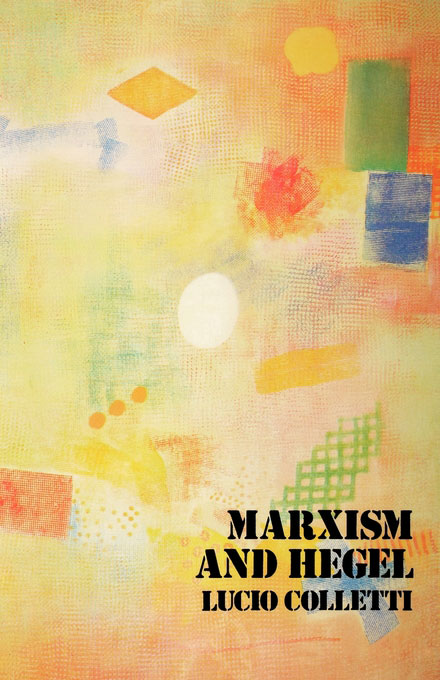
Lucio Colletti, Marxism and Hegel (1969)

Formats Available:
.PDF
From Verso Books:

"The interpretation of Hegel has been a focal point of philosophical controversy ever since the beginning of the twentieth century, both among Marxists and in the major European philosophical schools. Yet despite wide differences of emphasis most interpretations of Hegel share important similarities. They link his idea of Reason to the revolutionary and rationalist tradition which led to the French Revolution, and they interpret his dialectic as implying a latently atheist and even materialist world outlook.

Lucio Colletti directly challenges this picture of Hegel. He argues that Hegel was an essentially Christian philosopher, and that his dialectic was explicitly anti-materialist in both intention and effect. In contrast to earlier views, Colletti maintains that there is no contradiction between Hegel’s method and his system, once it is accepted that his thought is an exercise in Absolute Idealism stemming from a long Christian humanist tradition. He claims, on the contrary, that intellectual inconsistency is rather to be found in the works of Engels, Lenin, Lukás, Kojève and others, who have attempted to adapt Hegel to their own philosophical priorities.

Colletti places his argument in the context of a broad re-examination of the whole relationship between Marxism and the Enlightenment, giving novel emphasis to the relationship between Marxism and Kant. He concludes by re-asserting the importance in Marxism of empirical science against the claim of “infinite reason,” while at the same time showing how Marx did transform key ideas in Hegelian thought to construct a consistently materialist dialectic." 

Tuesday, November 11, 2014

Leon Trotsky on China. Introduction by Peng Shuzi

Formats Available:
Part 1 (PDF)
Part 2 (PDF)  
Part 3 (PDF)
HTML (coming soon)
This volume contains a collection of Trotsky's writings on the Chinese revolution of 1925-27 and its aftermath.

This failed revolution ended with the deaths of tens of thousands of communist workers and the total destruction of the Chinese Communist Party (CCP) as an organised mass movement of the working class. One cannot understand the fundamental problems in modern Chinese history, in particular the nature of the Maoist regime that was established in 1949, without understanding the lessons of 1925-27.

The perspective for the Chinese revolution was at the heart of Trotsky's struggle against the Stalinist bureaucracy. In this struggle, his theory of Permanent Revolution was put to a gigantic test—for the second time. With the support of the Soviet bureaucratic apparatus Stalin prevailed, leading to the betrayal of one of the most promising revolutionary opportunities since 1917. The defeat in China was a decisive blow to the Left Opposition. At the end of 1927, Trotsky was expelled from the Communist Party of the Soviet Union (CPSU) and then from the USSR.

Friday, October 10, 2014

Fred Moseley, Tony Smith, Marx's Capital and Hegel's Logic: A Reexamination


Fred Moseley, Tony Smith, Marx's Capital and Hegel's Logic: A Reexamination

Formats Available
.PDF
This book provides a wide-ranging and in-depth reappraisal of the relation between Marx’s economic theory in Capital and Hegel’s Logic by leading Marxian economists and philosophers from around the world. The subjects dealt with include: systematic dialectics, the New Dialectics, materialism vs. idealism, Marx’s ‘inversion’ of Hegel, Hegel’s Concept logic (universality-particularity-singularity), Hegel’s Essence logic (essence-appearance), Marx’s levels of abstraction of capital in general and competition, and capital as Hegelian Subject.

The papers in this volume were originally presented at the 22nd annual meeting of the International Symposium on Marxian Theory at Mount Holyoke College in August 2011. The twelve authors are divided between seven economists and five philosophers, as is fitting for the interdisciplinary subject of the relation between Marx’s economic theory and Hegel’s logic.

Contributors are: Chris Arthur, Riccardo Bellofiore, Roberto Fineschi, Gastón Caligaris, Igor Hanzel, Juan Iñigo Carrera, Mark Meaney, Fred Moseley, Patrick Murray, Geert Reuten, Mario Robles, Tony Smith, and Guido Starosta.

Fred Moseley, Martha Campbell, New Investigations of Marx's Method


Fred Moseley, Martha Campbell, New Investigations of Marx's Method

Formats Available
.PDF
The contributors to this stimulating collection of thoughtful essays examine the philosophical principles and logical structure underlying Marx's economic theory in Capital.

The essays deal with many methodological issues including: the meaning of dialectic logic, the relation between Marx and Hegel, the historical specificity of Marx's concepts, the emphasis on social forms, the commodity as the starting point of Capital, the theory of money, the distinction between capital in general and competition, and Marx's critique of bourgeois economics.

Wednesday, October 1, 2014

The Complete Works of Aristotle: The Revised Oxford Translation. Editied by Jonathan Barnes

Formats Available:
,PDF
The Oxford Translation of Aristotle was originally published in twelve volumes between 1912 and 1954. The revised edition contains the substance of the original translation, slightly emended in light of recent scholarship; three of the original versions have been replaced by new translations; and a new and enlarged selection of fragments has been added. The aim of the translation remains the same: to make the surviving works of Aristotle readily accessible to English-speaking readers.

Monday, September 8, 2014

Andrei Anikin, Science in Its Youth: Pre-Marxian Political Economy

Andrei Anikin, Science in Its Youth: Pre-Marxian Political Economy

Formats Available
.PDF
This book traces the link of major modern trends and ideas in political economy to economic doctrines 'of the past. With high scholarship warmed by humor, the reader is introduced to a host of earlier economic thinkers-Boisguillebert, Petty, Quesnay, Turgot, Smith, Ricardo, Saint-Simon, Fourier, Owen, and many others.

Their ideas are revealed against the background o( the age in which they. lived and wrote. The author Andrei Vladimirovich Anikin (Born Sep. 9, 1927 in Tomsk. Died August 29, 2001) was a professor at Moscow University.

A. Leontiev, Political Economy: A Beginner's Course

A. Leontiev, Political Economy: A Beginner's Course

Formats Available
.DJVU
Originally published in the Soviet Union in 1935, this was a popular Stalinist textbook on Marxism and how it related to the problems of the day. The book was used in Communist Party study classes for years.

Saturday, September 6, 2014

Erica Benner, Really Existing Nationalisms: A Post-Communist View from Marx and Engels

Erica Benner, Really Existing Nationalisms: A Post-Communist View from Marx and Engels

Formats Available
.PDF
This book counters a range of assumptions commonly held about Marx's views of nationalism and internationalism, not least by twentieth-century marxists themselves. It shows that Marx did not envisage the abolition of national communities or nation states; that the politics of nationalism in Marx is not incompatible with a politics of class; that Marx was repeatedly critical of a "utopian" internationalism, and that the themes of nationalism and international solidarity, far from being necessarily in opposition, can be seen in many cases as mutually reinforcing. Nationalism then emerges in Marxist theory as a form of political self-identification and mobilization that can contribute to the broader project of social and political freedom.

Scott Meikle, Essentialism in the Thought of Karl Marx


Scott Meikle, Essentialism in the Thought of Karl Marx

Formats Available
.PDF
Meikle emphasizes the roots of Marx's dialectical method in Aristotelian essentialism and organicism. This is shown to constitute a challenge to liberal scholars to rethink their methodological premises. Though many liberals claim Aristotle as their intellectual forebear, they haue not grasped the Aristotelian propensity for holistic analysis of social phenomena—as Marx did. In order to reclaim Aristotle's legacy, liberals must reformulate their economic and political ideas within a broader context that takes account of historical, cultural and socio‐psy‐chological factors.

Dianne Feeley, Paul Le Blanc, Thomas Twiss, George Breitman, Leon Trotsky and the Organizational Principles of the Revolutionary Party


Dianne Feeley, Paul Le Blanc, Thomas Twiss, George Breitman, Leon Trotsky and the Organizational Principles of the Revolutionary Party

Formats Available
.EPUB
This is the first comprehensive examination of Leon Trotsky's view on revolutionary organizational principles, and the dynamic interplay of democratic initiative and principled centralism. Mostly in his own words, these writings are grounded in Trotsky's experience in Russia's revolutionary movement, as a leader of the International Left Opposition and Fourth International.

Friday, September 5, 2014

V. Adoratsky, Dialectical Materialism: The Theoretical Foundation of Marxism-Leninism

V. Adoratsky, Dialectical Materialism: The Theoretical Foundation of Marxism-Leninism

Formats Available
.PDF
.DJVU

Clara Zetkin, Reminiscences of Lenin

Clara Zetkin, Reminiscences of Lenin

Formats Available
.PDF

Sebastian Budgen, Stathis Kouvelakis, Slavoj Zizek, David Fernbach, Lenin Reloaded: Toward a Politics of Truth

Sebastian Budgen, Stathis Kouvelakis, Slavoj Zizek, David Fernbach, Lenin Reloaded: Toward a Politics of Truth

Formats Available
.PDF
Lenin Reloaded is a rallying call by some of the world’s leading Marxist intellectuals for renewed attention to the significance of Vladimir Lenin. The volume’s editors explain that it was Lenin who made Karl Marx’s thought explicitly political, who extended it beyond the confines of Europe, who put it into practice. They contend that a focus on Lenin is urgently needed now, when global capitalism appears to be the only game in town, the liberal-democratic system seems to have been settled on as the optimal political organization of society, and it has become easier to imagine the end of the world than a modest change in the mode of production. Lenin retooled Marx’s thought for specific historical conditions in 1914, and Lenin Reloaded urges a reinvention of the revolutionary project for the present. Such a project would be Leninist in its commitment to action based on truth and its acceptance of the consequences that follow from action.

These essays, some of which are appearing in English for the first time, bring Lenin face-to-face with the problems of today, including war, imperialism, the imperative to build an intelligentsia of wage earners, the need to embrace the achievements of bourgeois society and modernity, and the widespread failure of social democracy. Lenin Reloaded demonstrates that truth and partisanship are not mutually exclusive as is often suggested. Quite the opposite—in the present, truth can be articulated only from a thoroughly partisan position.

Contributors. Kevin B. Anderson, Alain Badiou, Etienne Balibar, Daniel Bensaïd, Sebastian Budgen, Alex Callinicos, Terry Eagleton, Fredric Jameson, Stathis Kouvelakis, Georges Labica, Sylvain Lazarus, Jean-Jacques Lecercle, Lars T. Lih, Domenico Losurdo, Savas Michael-Matsas, Antonio Negri, Alan Shandro, Slavoj Žižek

Theodor Adorno, Introduction to Sociology

Theodor Adorno, Introduction to Sociology

Formats Available
.PDF
Introduction to Sociology distills decades of distinguished work in sociology by one of this century's most influential thinkers in the areas of social theory, philosophy, aesthetics, and music.

It consists of a course of seventeen lectures given by Theodor W. Adorno in May-July 1968, the last lecture series before his death in 1969. Captured by tape recorder (which Adorno called "the fingerprint of the living mind"), these lectures present a somewhat different, and more accessible, Adorno from the one who composed the faultlessly articulated and almost forbiddingly perfect prose of the works published in his lifetime. Here we can follow Adorno's thought in the process of formation (he spoke from brief notes), endowed with the spontaneity and energy of the spoken word. The lectures form an ideal introduction to Adorno's work, acclimatizing the reader to the greater density of thought and language of his classic texts.

Delivered at the time of the "positivist dispute" in sociology, Adorno defends the position of the "Frankfurt School" against criticism from mainstream positivist sociologists. He sets out a conception of sociology as a discipline going beyond the compilation and interpretation of empirical facts, its truth being inseparable from the essential structure of society itself. Adorno sees sociology not as one academic discipline among others, but as an over-arching discipline that impinges on all aspects of social life.

Tracing the history of the discipline and insisting that the historical context is constitutive of sociology itself, Adorno addresses a wide range of topics, including: the purpose of studying sociology; the relation of sociology and politics; the influence of Saint-Simon, Comte, Durkheim, Weber, Marx, and Freud; the contributions of ethnology and anthropology; the relationship of method to subject matter; the problems of quantitative analysis; the fetishization of science; and the separation of sociology and social philosophy.